Ahmed
Kamel, PhD
Road safety engineer, statistician and applied AI engineer.
I measure risk on roads, from crash records to self-driving vehicle data, and build the AI tools that put that evidence to work.
Vancouver, BC
About
I have worked in transportation for about ten years: as a consultant in Cairo and Riyadh, in traffic operations at the City of Coquitlam, in road safety research for ICBC and the BC Injury Research and Prevention Unit, and now at Papyrus AI, the company I founded.
My PhD at the University of British Columbia asked a simple question: can self-driving vehicles tell us how dangerous a road is right now, before anyone crashes? I answered it with Bayesian extreme value models built on real automated-vehicle sensor data. The same habits run through all my work. I state the uncertainty, I test the claim before trusting it, and I hand decision makers tools they can run without me.
What I do
Road safety engineering
Network screening, countermeasure evaluation and design standards for a city, a province and a public insurer.
About 10 years in transportation engineering
Statistics and data science
Bayesian hierarchical and spatial models, extreme value theory and causal inference, with the uncertainty reported, not hidden.
60% lower crash-prediction error for ICBC
Applied AI engineering
Multi-agent LLM systems, hybrid retrieval, and evaluation gates that every change must pass before it ships.
500,000+ papers searchable in Librarian
AV safety
Safety evaluation from automated-vehicle data: near-miss extraction, extreme value risk models, and validation without crash records. The direction my work is heading.
4 first-author journal papers
Selected work
Research and Decision Systems
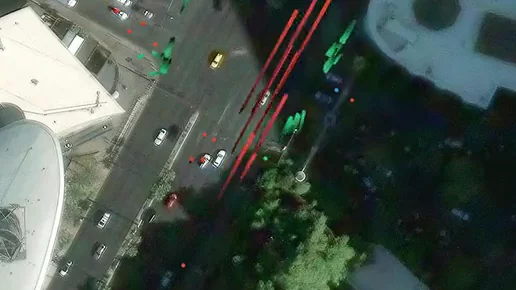
PhD research · University of British Columbia · 2020–2025
Real-time crash risk from self-driving vehicle data
Crashes are rare, and by the time they are counted, the danger has already happened. Automated vehicles record near-misses all day, but their data are sparse, noisy and different from city to city.
- Extreme value theory
- Bayesian hierarchical models
- Stan
- Conflict analysis
- Transferability
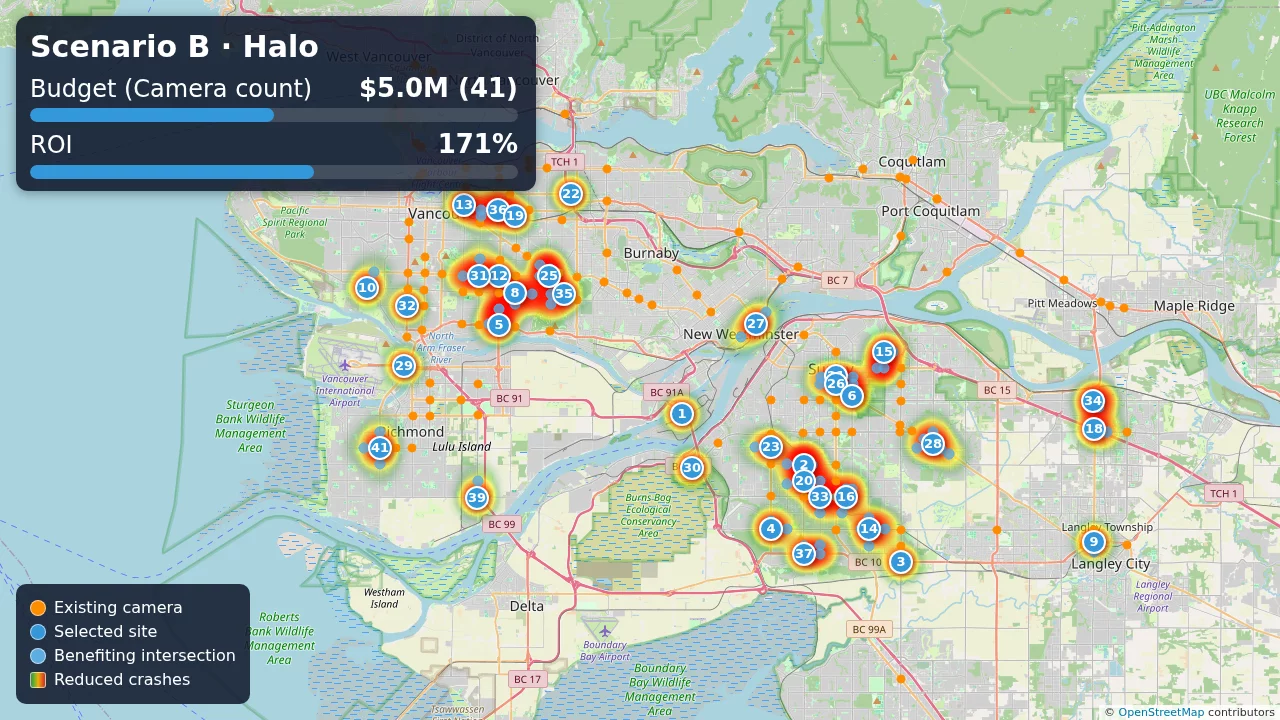
* Site choices rest on stated assumptions: crash modification factors, crash and camera costs, and how far a camera's effect reaches. Read the methodology (PDF)
ICBC and BC Injury Research and Prevention Unit · 2025–2026
Red-light camera site selection for ICBC
ICBC needed to choose red-light camera sites across BC. Traffic volumes were missing for most of the province's 20,000+ intersections, crash costs were still pending, and a camera also changes crashes at the intersections around it.
- BYM2 spatial model
- Monte Carlo
- CuPy
- MILP
- Genetic algorithms
- Decision support
Papyrus AI

Papyrus AI · 2025–present
Librarian
Researchers entering an unfamiliar field spend a long time finding and checking the literature before their real work can start.
What I did · Result
What I did
- Built a multi-agent research platform that answers questions over 500,000+ papers with citation-grounded reports.
- Combined keyword search, dense vector search and cross-encoder re-ranking in one retrieval pipeline.
- Designed evaluation gates and suites that every change must pass before it ships.
Result
- Piloted by the BC Injury Research and Prevention Unit, whose researchers get a faster, more complete way into unfamiliar literature, with every finding traceable to its source.
- Every change must pass evaluation gates. For example, I rejected an in-house re-ranker after a paired test on 66 questions showed it was 0.147 MRR@10 worse, with a confidence interval excluding zero.
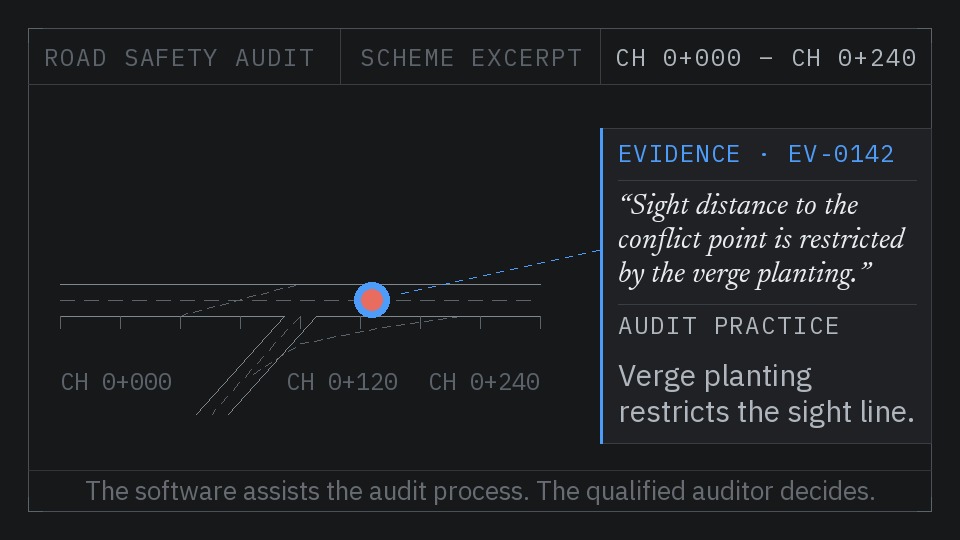
Papyrus AI · in development
AuditorAI
Road safety audits depend heavily on each auditor's experience, so coverage and consistency vary from one audit to the next.
What I did · Result
What I did
- Building an assistant that helps certified road safety auditors review drawings, photos and specifications faster and more completely, with the auditor always in charge.
- Tailors each audit to its jurisdiction, facility type and audit stage, keeping results consistent across projects while respecting local standards.
- Set it to flag a concern whenever in doubt, because a dismissed flag costs less than a missed hazard.
Result
- A work in progress, still being calibrated. Learning from dismissed flags is in development.

Papyrus AI · 2025–present
Mission Control
Existing drone apps were not cross-platform, and desktop mission software costs thousands of dollars.
What I did · Result
What I did
- Built a cross-platform web mission planner that sends flight plans through cloud storage to the drone's controller.
- Chained open-source reconstruction, 3D modelling, cleaning and reporting tools into one survey pipeline.
Result
- Turns drone footage into orthomosaic maps and explorable 3D scenes with Gaussian Splatting.
- End-to-end mission tests run in CI on every push.
- Replaced desktop software costing thousands of dollars.
Engineering practice
SETS International · 2015–2019
Riyadh's regional travel-demand model, and Cairo's first shared bike network
Riyadh needed a regional travel-demand model for strategic planning, and Cairo needed its first shared bike-lane network.
- Travel demand modelling
- TransCAD
- PTV Vissim
- Survey design
- International development
What I did · Result
What I did
- Built Riyadh's regional travel-demand model from scratch with the modelling team: I designed the household, stated-preference and roadside-interview surveys, selected 150+ continuous count locations, and helped calibrate trip generation and mode choice.
- Calibrated travel times with a crowd-sourced method, later published.
- Built a decision tool that lets non-technical ministry managers run scenarios themselves.
- In Cairo, working with UN-Habitat and Egyptian law enforcement on a program funded by the World Bank, led data collection, network design, modelling, scenario planning and mode-choice analysis.
Result
- The city's Ministry of Transportation uses the Riyadh model for strategic planning, traffic impact studies and transit ridership tests.
- Cairo got its first shared bike-lane network design.
Traffic Technologist · 2023–2024
Safety evidence for the City of Coquitlam
A limited safety budget, and no clear evidence of which sites needed it most or which past treatments had worked.
- Network screening
- Causal inference
- Benefit-cost analysis
- Design standards
- Synchro
What I did · Result
What I did
- Screened the city's intersections and road segments and traced the crash patterns at the riskiest sites.
- Built benefit-cost cases for the candidate treatments.
- Tested past countermeasures with difference-in-differences and propensity-score matching.
- Verified a consultant-built conflict dashboard before each release to senior management.
Result
- The analysis set the city's capital priorities for traffic safety.
- The multi-use-path crossing standards I wrote were adopted and are used to review developers' drawings.
- I also drafted the RFP for a city-wide speed management strategy.
Experience
Founder & Applied AI Engineer
- Built Librarian, AuditorAI and Mission Control end to end, under one shared sign-in.
- Designed the evaluation gates and paired tests that decide which changes ship.
- Built hybrid retrieval at scale: GPU-accelerated embeddings, dense and BM25 sparse search, cross-encoder re-ranking and HyDE query expansion over 500,000+ papers, at under 2 s P95 end-to-end latency.
- Owned the stack: Python services in Docker, fault-tolerant ingestion with checkpoint and retry, a streaming response layer and GitHub Actions CI/CD.
Road Safety Researcher
- Built optimization and prediction models for ICBC whose outputs informed policy, reporting and capital allocation.
- Shipped a resource-allocation decision tool, genetic algorithms with Monte Carlo simulation under budget constraints, with interactive scenario dashboards for non-technical users.
- Developed spatial hierarchical Bayesian models that cut prediction error by about 60%, with calibrated uncertainty.
- Evaluated interventions with causal inference: propensity score matching and difference-in-differences.
Graduate Researcher, PhD
- Developed Bayesian hierarchical and extreme value models for real-time crash risk from 1,000+ hours of autonomous-vehicle data, published in four peer-reviewed papers.
- Made the models portable with informative priors, holding up with about 20% of the usual training data.
- Captured traffic by drone and fine-tuned YOLO detectors on patched aerial imagery.
- Led the evaluation of High-Friction Surface Treatments with the BC Ministry of Transportation and Infrastructure.
Traffic Technologist
- Led technical reviews of traffic control devices, from signage and pavement markings to crosswalk upgrades and traffic calming, based on collision history, volumes and field conditions.
- Performed road safety audits and screened high-crash locations from ICBC collision reports, prioritizing treatments with crash modification factors and collision costs.
- Drafted the RFP for a city-wide Speed Management Strategy and led design standards for multi-use path crossings.
Transportation Engineer
- Led development of Riyadh's regional four-step travel demand model.
- Designed Cairo's first shared bike lane network with UN-Habitat, funded by the World Bank.
- Pioneered crowd-sourced calibration and validation where surveillance data was thin; the method was published in a peer-reviewed journal.
- Delivered traffic impact assessments, with PTV Vissim micro-simulation of sub-areas cut from the regional model.
Publications
- 2025Real-time crash risk estimation with autonomous vehicle data: a comparative analysis of extreme value modelsKamel, A. et al. · Transportmetrica A: Transport Science
- 2024Real-time combined safety-mobility assessment using self-driving vehicles collected dataKamel, A. et al. · Accident Analysis & Prevention
- 2024Transferability of real-time EVT safety models: an investigation using autonomous vehicles dataKamel, A. et al. · Transportmetrica A: Transport Science
- 2023Real-time safety analysis using autonomous vehicle data: a Bayesian hierarchical extreme value modelKamel, A. et al. · Transportmetrica B: Transport Dynamics
- 2021Real-time traffic flow estimation based on open-source travel time dataKamel, A. et al. · Advances in Transportation Studies
Skills
Road safety
- Network screening
- Before-and-after evaluation
- Traffic conflict analysis
- Countermeasure evaluation
- Benefit-cost analysis
- Warrant analysis
Statistics
- Bayesian hierarchical and spatial models
- Extreme value theory
- Causal inference (DiD, PSM)
- Monte Carlo simulation
- Uncertainty quantification
- Optimization (MILP, genetic algorithms)
Applied AI
- Multi-agent LLM systems
- RAG and hybrid retrieval
- Evaluation design
- PyTorch
Transportation modelling
- Travel demand modelling
- TransCAD
- PTV Vissim and Visum
- Synchro
- SIDRA
Engineering
- Python
- SQL
- Stan
- PyMC
- CuPy
- Docker
- GitHub Actions
- GIS
Education
- PhD, Civil EngineeringUniversity of British Columbia · Dissertation: Real-time safety and mobility assessment using extreme value theory modeling: an investigation using real-world self-driving vehicles dataset
- MSc, Civil Engineering (Public Works – Highways and Traffic)Cairo University
- BSc, Civil EngineeringCairo University · Distinction with Honour
- P.Eng. application in progressEngineers and Geoscientists BC